Ajax
AFC Ajax is a Dutch professional football club based in Amsterdam that plays in the Eredivisie, the top tier of Dutch football. Founded on 18 March 1900, the club is historically the most successful in the Netherlands with 36 Eredivisie titles and 20 KNVB Cups. Ajax plays at the Johan Cruyff Arena, which opened in 1996 and was renamed in 2018. The club is renowned for its youth academy, Total Football philosophy, and remarkable achievements including three consecutive European Cups (1971-1973) and the 1995 Champions League victory. Ajax is one of only five clubs to have won all three major UEFA competitions and remains one of the Netherlands' "big three" clubs alongside Feyenoord and PSV Eindhoven.
History
Overview
General information about the club
AFC Ajax was founded in Amsterdam on 18 March 1900 and is named after the legendary Greek hero Ajax. The club achieved promotion to the highest level of Dutch football in 1911 and has continuously played in the Eredivisie since the league's inception in 1956. Throughout its history, Ajax has cultivated a reputation for scouting, spotting and developing young talent through its renowned youth system. The club is one of the Netherlands' "big three" along with Feyenoord and PSV Eindhoven.
Most recent season and achievements
In recent seasons, Ajax has experienced both triumph and turbulence. The 2021-22 season saw Ajax become champions of the Netherlands again, though they lost the KNVB Cup and Johan Cruijff Shield finals to PSV. In European competition, they achieved first place in their Champions League group, winning all six matches, but were eliminated by Benfica in the round of 16. The 2022-23 season marked a significant decline, with Ajax finishing third in the Eredivisie behind champions Feyenoord and runners-up PSV - their lowest ranking since 2008-09. The 2023-24 season saw Ajax reach a historic low, briefly sitting in last place for the first time in club history before recovering to finish fifth under John van 't Schip.
History
Early years
Ajax was founded on 18 March 1900 and achieved its first major success in 1917 by winning the KNVB Beker. The following season, Ajax became national champion for the first time and defended its title in 1918-19, becoming the only team to achieve an unbeaten season in the Netherlands Football League Championship. Throughout the 1920s, Ajax was a strong regional power, and this success expanded in the 1930s when the club won five national championships (1931, 1932, 1934, 1937, 1939). Under the management of Englishman Jack Reynolds, who oversaw all national championship successes until 1947, Ajax established itself as a dominant force in Dutch football.
Successful period
The most successful period in Ajax's history began in 1965 when Rinus Michels was appointed manager, implementing his philosophy of Total Football. Together with Johan Cruyff, who had made his debut in 1964, Michels led Ajax through an unprecedented era of success. Between 1966 and 1973, Ajax won seven Eredivisie titles, four KNVB Cups, and three consecutive European Cups (1971, 1972, 1973). The 1971-72 season saw Ajax complete a continental treble, and they also won the Intercontinental Cup in 1972, becoming the first club to win three consecutive European Cups since Real Madrid in the 1950s.
A second golden era emerged in the 1990s under Louis van Gaal. After winning the UEFA Cup in 1992, van Gaal assembled a team featuring academy graduates like the De Boer twins, Edwin van der Sar, Clarence Seedorf, and Edgar Davids, alongside talents like Jari Litmanen and Finidi George. This team won three consecutive Eredivisie titles (1994-1996) and achieved the pinnacle of success in 1994-95 by completing an unbeaten league season and defeating Milan 1-0 in the Champions League final, with 18-year-old Patrick Kluivert scoring the winning goal.
Crisis and recovery
The late 1990s and 2000s marked a decline for Ajax as key players and staff departed for Europe's biggest clubs. The 2000s was a lean decade with only two Eredivisie championships won, though the academy continued producing talents like Wesley Sneijder and Rafael van der Vaart. Recovery began in 2010 when Frank de Boer was appointed manager, leading Ajax to four consecutive league titles (2011-2014) for the first time in club history. Under Peter Bosz, Ajax reached the 2017 Europa League final, losing to Manchester United with the youngest lineup ever in a European final.
Current period
The 2018-19 season marked a remarkable resurgence as Ajax embarked on a stunning Champions League run, defeating Real Madrid 4-1 at the Santiago Bernabéu and eliminating Juventus to reach the semi-finals, where they were dramatically eliminated by Tottenham via the away goals rule. However, recent years have brought instability with multiple coaching changes. Erik ten Hag departed for Manchester United in 2022, followed by unsuccessful tenures under Alfred Schreuder and Maurice Steijn. The 2023-24 season saw Ajax briefly in last place before Francesco Farioli was appointed, leading to some recovery, though he departed in May 2025 after tensions over transfers and tactics.
Achievements and Honors
Domestic competitions
Ajax is the most successful club in Dutch football history with 36 Eredivisie titles since the league's inception in 1956. The club has also won 20 KNVB Cups, with their first major trophy being the 1917 KNVB Beker. Notable achievements include completing unbeaten seasons in 1918-19 and 1994-95, and winning four consecutive Eredivisie titles from 2011-2014 under Frank de Boer. Ajax has also claimed multiple Johan Cruijff Shield victories and holds the record for most goals scored in an Eredivisie season with 122 goals in 1966-67.
Continental and global competitions
Ajax's international trophy cabinet includes three consecutive European Cups (1971, 1972, 1973) and the 1995 Champions League. The club is one of only five teams to have won all three major UEFA competitions, having also claimed the 1987 Cup Winners' Cup and the 1992 UEFA Cup. Ajax won the Intercontinental Cup twice (1972, 1995) and the UEFA Super Cup in 1995. The club completed a continental treble in 1972 and is one of only four teams to win both the continental treble and Intercontinental Cup in the same season. According to various international rankings, Ajax was named World Team of the Year in 1995 and was recognized as one of the most successful European clubs of the 20th century.
Symbols and Colors
Current logo and logo history
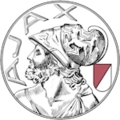
When Ajax was founded in 1900, the emblem was simply a picture of an Ajax player. Following promotion to the top division in 1911, the crest was altered to match the club's new outfits. In 1928, the club introduced a logo featuring the head of the Greek hero Ajax. This design was modernized in 1990 into an abstract version drawn with just 11 lines, symbolizing the 11 players of a football team. On 17 November 2024, Ajax announced that the classic 1928 logo would return for the 2025-26 season, making a comeback after 34 years.
Traditional home and away kits colors
Ajax originally played in an all-black strip with a red sash tied around players' waists, reflecting the colors of Amsterdam's flag (red, black, and white). However, upon promotion to the top flight in 1911 under manager Jack Kirwan, Ajax was forced to change colors because Sparta Rotterdam had identical uniforms. Ajax adopted white shorts and a white shirt with a broad, vertical red stripe over chest and back, which remains the club's traditional home outfit. This distinctive red and white striped design has become synonymous with Ajax's identity and continues to be worn today.
Traditional club anthem
The source material does not contain specific information about Ajax's traditional club anthem, though it mentions that ringtones of "Hava Nagila," a Hebrew folk song, could once be downloaded from the club's official website as part of the Jewish cultural imagery that became associated with Ajax supporters.
Traditional Rivals
Feyenoord
Feyenoord from Rotterdam is Ajax's archrival, and their matches are known as "De Klassieker" (The Classic). This rivalry represents a clash between the two largest cities in the Netherlands and is seen as "the graceful and elegant football of Ajax against the indomitable fighting spirit of Feyenoord" - the confidence of the capital city versus the blue-collar mentality of Rotterdam. Until the 1973-74 season, Ajax and Feyenoord were the only two clubs capable of winning national titles and achieving continental success. Matches are known for their tension and violence both on and off the pitch, leading to the current prohibition of away supporters in both stadiums. The lowest point occurred on 23 March 1997 during the "Battle of Beverwijk," when Ajax supporter Carlo Picornie was fatally injured in clashes between rival supporters.
PSV Eindhoven
PSV represents Ajax's second major rivalry, with matches commonly referred to as "De Topper." This rivalry involves the two most trophy-laden sides in Dutch football and represents a clash of competing football philosophies. While Ajax embraces the Total Football approach developed by Rinus Michels and Johan Cruyff, PSV traditionally employs a more workmanlike ethic with robust formations, developed under coaches like Kees Rijvers and Guus Hiddink. This has created one of football's more philosophical rivalries - an ideological battleground that has gradually become as heated and intense as the Ajax-Feyenoord matches.
AZ Alkmaar
A more recent rivalry has developed with AZ from nearby Alkmaar, known as "De Noord-Hollandse derby" (The North Holland derby). Although the clubs first met in the 1960s, the rivalry intensified when AZ won the Dutch championship in 2009. Despite many Ajax supporters regarding AZ as their "little brother," it remains a competitive and emotionally charged fixture. Notable incidents include a December 2011 KNVB Cup match where an Ajax supporter attacked AZ goalkeeper Esteban Alvarado, leading to the match being abandoned. The rivalry extends beyond the pitch as both clubs compete for staff and youth prospects in the North Holland region.
Club Traditions and Behind the Scenes
Sponsors
Ajax's shirt sponsorship history includes TDK (1982-1991), ABN AMRO (1991-2008), AEGON (2008-2015), and Ziggo (2015-present). The Ziggo deal, announced in 2014, was worth €8 million annually over four and a half years. Kit manufacturers have included Le Coq Sportif, Puma, Umbro, and Adidas (since 2000, contracted until at least 2025). Ajax won the Football Shirt of the Year award in 2014 for its black and rose colored away shirt by Adidas.
Nicknames
Ajax is commonly known by several nicknames, with "Lucky Ajax" being one of the most famous, derived from occasions when the club would win matches by chance, referee decisions, or coincidence. The club is also referred to as "de Godenzonen" (the Sons of the Gods) and "Mr. Ajax" was the nickname given to Sjaak Swart, who holds the record for most appearances with 463 matches.
Ownership and finances
Ajax is unique as the only Dutch club with an initial public offering (IPO), listed on Euronext Amsterdam since 17 May 1998. With a launch price of 25 guilders, the club raised €54 million in its first year. However, criticism emerged that the commercial structure was unsuitable for a football club, and share prices fluctuated significantly. In 2008, a commission concluded the IPO was of no value to the club, though Ajax remains on the stock exchange.
Traditions and culture
Ajax has developed a unique cultural identity, particularly regarding its Jewish connection. Since the 1930s, when the stadium was located next to a Jewish neighborhood, Ajax acquired a Jewish image. Supporters embraced this identity by calling themselves "super Jews," chanting "Joden, Joden" at games, and adopting Jewish symbols. This led to anti-Semitic responses from rival supporters, though the club has since tried to discourage this imagery. Ajax is also famous for its youth academy philosophy and the development of Total Football under Rinus Michels.
Stadium
Ajax plays at the Johan Cruyff Arena, which opened as the Amsterdam Arena in 1996 and was renamed in 2018. The stadium can hold 55,865 spectators and features a retractable roof, setting trends for modern European stadiums. Previously, Ajax played at Het Houten Stadion (1911), the Olympic Stadium (for big matches), and De Meer Stadion (1934-1996). The Arena initially suffered from poor grass conditions due to insufficient sunlight, but an artificial lighting system introduced in 2008-09 significantly improved this problem.